
Ensuring Policy Adherence: How Employees Verify Their Understanding
 Sofia Kargioti
In the dynamic realm of the Medical Device industry, where precision and strict adherence to regulations are imperative, one innovative company shines. Although the identity of our protagonist remains undisclosed for confidentiality reasons, the profound impact of their dedication to policy adherence reverberates throughout the industry.
In the complex world of healthcare and medical devices, policies serve as the backbone, guiding organizations through the complexities of compliance and ethical standards. Our anonymous protagonist, a leading medical device entity based in Europe, operates at the intersection of innovation and patient care, embodying a commitment to excellence that sets the industry standard.
Potential Consuquenses of Non-Compliance
In an industry where the stakes are nothing short of human well-being, the consequences of non-compliance loom large. Our medical device protagonist recognized the gravity of the situation and, in doing so, safeguarded not only their reputation but, more importantly, the health and safety of patients.
-
Legal Ramifications: Non-compliance with healthcare and medical device regulations invites legal repercussions that can have severe financial implications. Fines, penalties, and potential legal action can cripple an organization, soiling its reputation and jeopardizing its financial stability.
-
Compromised Patient Care: The sector's primary goal is to supply optimal solutions to healthcare providers. Non-compliance not only jeopardizes patient safety but can also compromise the quality of healthcare services. Our protagonist understood that adherence to policies directly correlates with the delivery of safe and effective patient care.
-
Damage to Reputation: Medical device is a trust-based industry, and any hint of non-compliance can quickly break that trust. Negative publicity and damage to the company's reputation can lead to a loss of partners, customers, and investors, creating a ripple effect that is challenging to reverse.
-
Operational Disruptions: Non-compliance can disrupt day-to-day operations, leading to inefficiencies, increased costs, and a potential breakdown of internal processes. Our medical device protagonist recognized that a harmonized approach to policy adherence was not just a compliance checkbox but a strategic imperative for smooth operations.
Applicability to Other Businesses
In the ever-evolving landscape of regulatory requirements and employee training within industries such as medical devices and healthcare, the QC Read and Understood app for Confluence Cloud emerges as a powerful ally. Tailored for employee training and compliance management, this tool provides a streamlined approach for Confluence administrators to ensure that employees not only access but genuinely comprehend critical information. Let's explore the potential benefits of the QC R&U app and how its adoption can impact companies within the same industry.
-
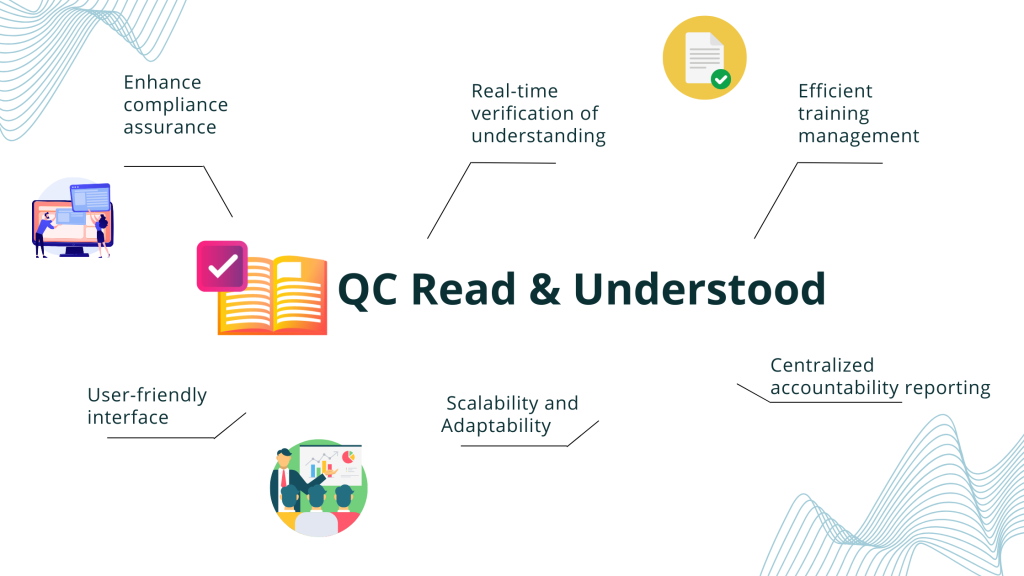
Enhanced Compliance Assurance: The foremost advantage of the QC R&U app lies in its ability to reinforce compliance within the organization. By allowing administrators to assign specific pages for mandatory reading, the app ensures that employees are up-to-date with the latest policies, regulations, and procedural changes. This feature is particularly crucial in highly regulated industries such as medical devices and healthcare, where adherence to compliance standards is non-negotiable.
-
Real-Time Verification of Understanding: The app's functionality to require employees to actively click the R&U button after reading a page goes beyond mere acknowledgment. It serves as a real-time verification of understanding, providing administrators with confidence that employees have not only accessed the information but have comprehended it. This level of engagement is invaluable in industries where the consequences of misunderstanding procedures or regulations can be severe.
-
Efficient Training Management: Assigning users to R&U specific pages streamlines the training process. It ensures that employees receive targeted information relevant to their roles and responsibilities. This efficiency is especially advantageous in industries where time is of the essence, allowing employees to access and understand critical information promptly.
-
Centralized Reporting for Accountability: The ability for administrators to generate comprehensive reports of all R&Us enhances accountability across the organization. This centralized reporting feature is instrumental in audits, compliance checks, and reporting requirements, offering a bird's-eye view of the organization's overall adherence to training protocols.
-
Scalability and Adaptability: The QC - R&U app is designed to scale with the organization's growth. As teams expand and regulatory landscapes evolve, the app can easily adapt to changing training needs. This scalability ensures that the organization remains agile and responsive to new compliance challenges without overhauling its training infrastructure.
-
User-Friendly Interface for Seamless Adoption: The user-friendly nature of the app facilitates easy adoption by employees and administrators alike. Its integration with Confluence Cloud provides a familiar environment, reducing the learning curve and encouraging widespread usage. In industries where technological solutions must be user-friendly to gain widespread acceptance, this feature is particularly advantageous.
In adopting a similar approach to employee training and compliance verification, companies in the same industry can fortify their internal processes, reduce the risk of non-compliance, and foster a culture of continuous learning. The QC R&U app for Confluence Cloud exemplifies a proactive and efficient solution, aligning seamlessly with the needs of industries where regulatory adherence is paramount.